Table of contents
- What is a School Management Committee (SMC)?
- Objectives of School Management Committees
- Formation of School Management Committee (SMC)
- Composition of School Management Committee
- Election Process of Parent Members in SMC
- Roles and Responsibilities of School Management Committee (SMC)
- 1. Ensuring Enrollment and Retention
- 2. Supporting Foundational Literacy and Numeracy (FLN)
- 3. Monitoring Academic Activities
- 4. Supporting PM POSHAN Scheme
- 5. Infrastructure Development
- 6. Financial Management and Transparency
- Financial Responsibilities Include:
- 7. Child Safety and Well-being
- SMCs Monitor:
- School Development Plan (SDP)
- SMC Meetings and Procedures
- Capacity Building and Training of SMC Members
- Community Participation and CSR Support
- Importance of School Management Committees
- Conclusion
- Important Links:
Key Takeaways
- The SMC Guidelines 2026 empower community participation and improve India’s education system through better governance.
- School Management Committees (SMCs) strengthen accountability, transparency, and inclusivity in schools, ensuring quality education for all.
- SMCs comprise parents, teachers, and local community members, with specific rules for composition to promote diversity and inclusion.
- Key responsibilities include enrollment support, monitoring academic activities, and ensuring child safety and well-being.
- The guidelines align with NEP 2020 and aim to create child-friendly, accountable educational institutions across India.
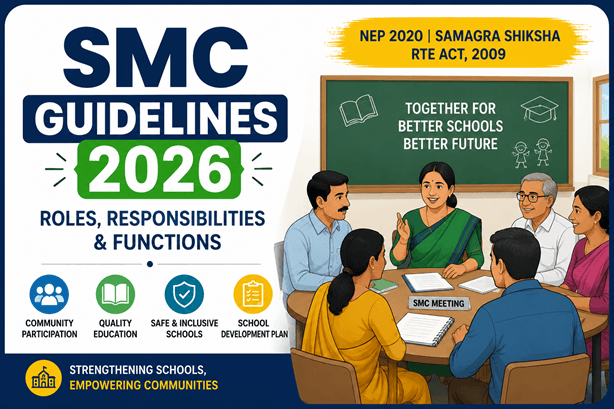
School Management Committees (SMCs) play a vital role in strengthening India’s education system through community participation, transparency, and inclusive school governance. The Department of School Education and Literacy, Ministry of Education, Government of India released the updated Guidelines for School Management Committees (SMCs) 2026 to empower schools, parents, teachers, and local communities in improving learning outcomes and ensuring quality education for every child.
In this detailed guide, we will understand the meaning of SMC, composition of SMC, roles and responsibilities of School Management Committees, School Development Plan (SDP), financial management, safety measures, and important provisions under the National Education Policy (NEP) 2020 and the Right to Education (RTE) Act 2009.
The SMC Guidelines 2026 released by the Ministry of Education provide a detailed framework for strengthening school governance, community participation, safety, academic monitoring, and inclusive education in schools across India.
What is a School Management Committee (SMC)?
A School Management Committee (SMC) is a community-based governing body formed in schools to ensure proper planning, monitoring, and development of educational activities. It acts as a bridge between schools and local communities.
The National Education Policy (NEP) 2020 and the Right of Children to Free and Compulsory Education (RTE) Act, 2009 emphasize active participation of parents, teachers, alumni, local authorities, and community members in school governance.
The SMC helps schools become more inclusive, transparent, accountable, child-friendly, and focused on quality learning outcomes.
Objectives of School Management Committees
The major objectives of SMCs include:
- Strengthening decentralized school governance
- Improving quality education
- Ensuring community participation
- Monitoring school functioning
- Supporting enrollment and retention of children
- Promoting inclusive education
- Preparing School Development Plans (SDPs)
- Ensuring safety and well-being of students
- Monitoring utilization of school funds
- Supporting Foundational Literacy and Numeracy (FLN)
These guidelines align with the vision of NEP 2020, Samagra Shiksha, NIPUN Bharat Mission, and PM SHRI Schools.
Formation of School Management Committee (SMC)
According to the 2026 guidelines, every school should form an SMC within one month from the beginning of the academic year. States and Union Territories are also encouraged to establish SMCs in secondary schools up to Grade 12.
Number of Members in SMC
The number of SMC members depends on student enrollment:
| Enrollment Range | Approximate Members |
|---|---|
| Up to 100 students | 12–15 members |
| 100–500 students | 15–20 members |
| Above 500 students | 20–25 members |
Composition of School Management Committee
The composition of the SMC ensures representation from parents, teachers, local authorities, and experts.
Important Rules for SMC Composition
- 75% members must be parents or guardians of students
- 50% members must be women
- Representation must be given to:
- SC/ST/OBC communities
- Socio-Economically Disadvantaged Groups (SEDGs)
- Children With Special Needs (CwSN)
Members of SMC
The committee generally includes:
- Chairperson (Parent/Guardian Representative)
- Vice-Chairperson
- Parent representatives from different grades
- Teachers from the school
- Local authority members
- Educationists and subject experts
- Alumni and senior students
- Anganwadi Workers (AWWs)
- ASHA workers
- ANM representatives
- Principal or Headmaster as Member-Secretary
Tenure of SMC Members
The tenure of School Management Committee members is two years. Members may be re-nominated, but no member can continue for more than two consecutive terms except the Member-Secretary.
Membership may end if:
- The child leaves the school
- The member migrates
- The member is absent in four consecutive meetings
- Conviction in criminal cases
- Death of member
Election Process of Parent Members in SMC
The election process must be democratic, transparent, and inclusive.
Key Guidelines for Elections
- Only one parent or guardian per child can vote
- Parents may nominate themselves or others
- Minimum 50% quorum is required
- Secret ballot can be used during disputes
- Representation from all classes and disadvantaged groups must be ensured
After formation, the first SMC meeting should be held within one week.
Roles and Responsibilities of School Management Committee (SMC)
The SMC performs many important functions to improve school quality, student learning, and community participation.
1. Ensuring Enrollment and Retention
SMCs help identify out-of-school children and support enrollment drives. They work to prevent dropouts and ensure inclusive education for all children, especially disadvantaged groups and children with disabilities.
2. Supporting Foundational Literacy and Numeracy (FLN)
The committee supports the goals of the NIPUN Bharat Mission by promoting:
- Reading culture
- Storytelling sessions
- Parent-led reading clubs
- Multilingual teaching-learning materials
- Local language learning support
The goal is to ensure every child achieves foundational literacy and numeracy skills.
3. Monitoring Academic Activities
SMCs monitor:
- Teacher attendance
- Student attendance
- Completion of syllabus
- Classroom activities
- Learning outcomes
- Parent-Teacher Meetings (PTMs)
They also support project-based learning, bagless days, experiential learning, internships, and skill development activities aligned with NEP 2020.
4. Supporting PM POSHAN Scheme
SMCs actively monitor the implementation of the PM POSHAN scheme by:
- Checking food quality
- Promoting hygiene
- Supporting nutrition gardens
- Encouraging Tithi Bhojan initiatives
- Organizing health and nutrition awareness activities
5. Infrastructure Development
The committee helps improve school infrastructure such as:
- Clean classrooms
- Drinking water
- Toilets
- Boundary walls
- Ramps for accessibility
- Libraries
- STEM Labs
- Atal Tinkering Labs
- Sports facilities
- Digital learning tools
SMCs also support the Building as Learning Aid (BaLA) initiative.
6. Financial Management and Transparency
SMCs oversee school funds and ensure transparency in spending.
Financial Responsibilities Include:
- Maintaining separate bank accounts
- Recording expenditures
- Maintaining cash books
- Conducting social audits
- Maintaining stock and asset registers
- Reviewing school budgets
- Monitoring grants and scholarships
All records should be publicly displayed for accountability.
7. Child Safety and Well-being
One of the most important functions of SMCs is ensuring a safe and child-friendly environment.
SMCs Monitor:
- POCSO Act implementation
- Anti-bullying measures
- School safety plans
- Emotional well-being of students
- Mental health support
- Disaster preparedness drills
- Child protection mechanisms
Schools must display information related to child safety, grievance committees, and emergency contacts.
School Development Plan (SDP)
The School Development Plan (SDP) is one of the most important responsibilities of the SMC.
What is SDP?
The SDP is a strategic three-year plan that focuses on:
- Enrollment improvement
- Teacher requirements
- Infrastructure needs
- Financial planning
- Learning outcomes
- Inclusive education
- School performance improvement
Important Features of SDP
The School Development Plan should include:
- Class-wise enrollment estimates
- Additional teacher requirements
- Infrastructure development plans
- Budget estimates
- Academic goals
- Student support measures
The SDP must be reviewed annually and placed in the public domain for transparency.
SMC Meetings and Procedures
Regular meetings are essential for effective school governance.
Meeting Guidelines
- Meetings should be held at least once every month
- Minimum 50% quorum is mandatory
- Minutes of meetings should be recorded
- Feedback registers and suggestion boxes should be maintained
- PTAs should be integrated into SMC functioning
Capacity Building and Training of SMC Members
The guidelines emphasize regular training and orientation programs for SMC members.
Training Topics Include:
- NEP 2020
- School Development Plans
- Financial management
- Social audits
- Digital literacy
- Inclusive education
- Student safety
- Academic monitoring
Digital platforms like DIKSHA, NISHTHA, and ULLAS can also be used for blended learning and training.
Community Participation and CSR Support
The SMC can mobilize support from:
- Alumni
- NGOs
- Volunteers
- Local businesses
- Corporate Social Responsibility (CSR) initiatives
- Civil Society Organizations (CSOs)
The Vidyanjali initiative also encourages volunteers and professionals to contribute to schools.
Importance of School Management Committees
School Management Committees are essential because they:
- Improve accountability in schools
- Strengthen community ownership
- Enhance student learning
- Promote inclusive education
- Improve transparency
- Encourage parent participation
- Ensure safety and well-being of children
- Help schools become vibrant learning centers
Strong and active SMCs can transform schools into community-driven institutions focused on quality education and holistic child development.
Conclusion
The Guidelines for School Management Committees (SMCs) 2026 provide a comprehensive framework for strengthening school governance and community participation in India’s education system. Through collaborative efforts of parents, teachers, local authorities, and community members, SMCs can significantly improve educational quality, transparency, safety, and inclusiveness in schools.
Aligned with the vision of NEP 2020, Samagra Shiksha, and NIPUN Bharat, empowered School Management Committees can help build child-friendly, future-ready, and accountable schools across the country.
Important Links:
- Download Official PDF
- CBSE Affiliation Guide
- CBSE Affiliation Audit Process
- CBSE Official Website